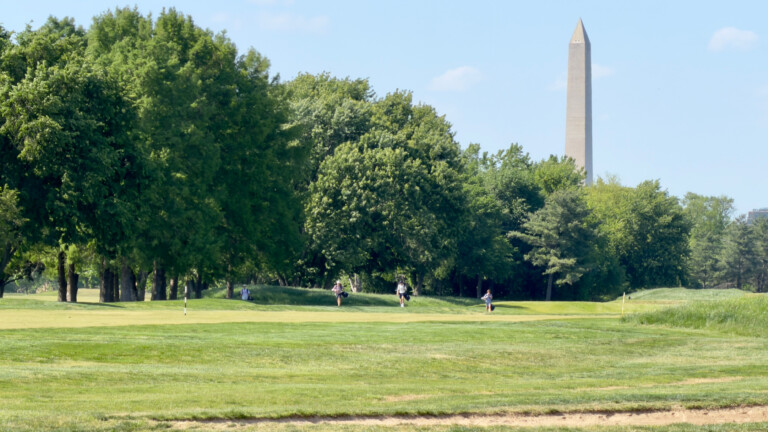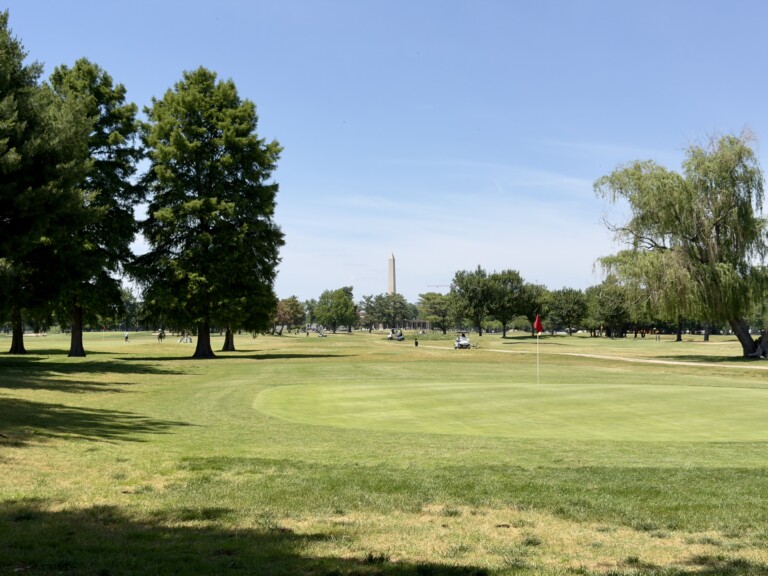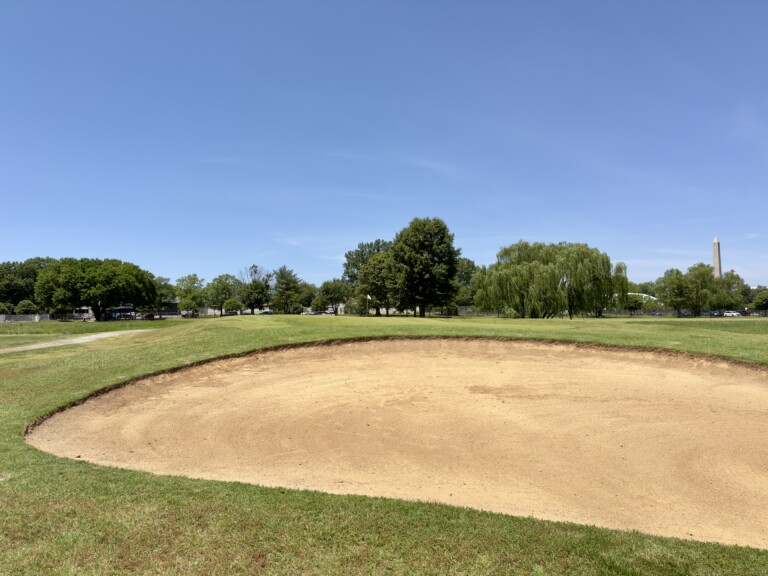
There are courses in better shape in the DMV, and there are more challenging designs, but there’s nothing else quite like a loop at East Potomac Golf Links. DC is in the air and history is at your feet. The Washington Monument over one shoulder, jets taking off from Reagan National over the other. Between the helicopters overhead and the Jefferson Memorial across the channel, it’s easy to forget you’re at a venue that hosted a national championship the same year its eighteen hole course was finished, and the spot where a 1941 protest forced the capital’s federal courses to integrate.
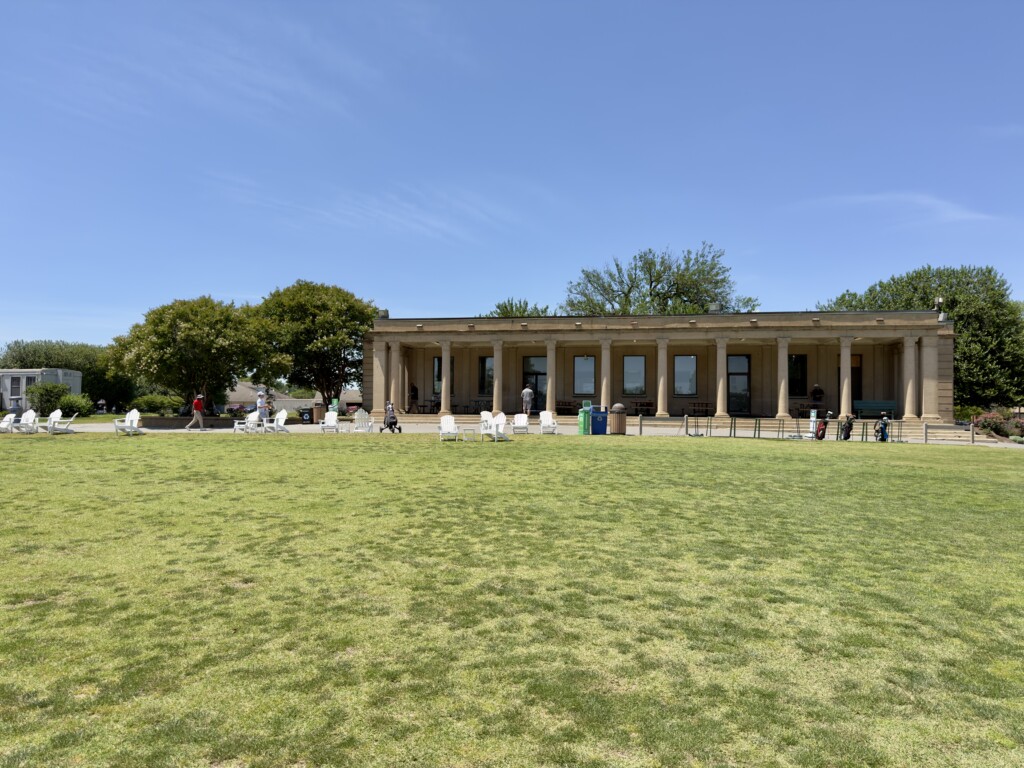
The complex packs a lot onto its man-made island: 36 holes across three courses, a historic miniature course, a driving range, putting greens, practice holes, and the Potomac Grille. Pace is slow, so unless you book one of the first tee times of the day, know it’ll be a leisurely walk. And yes, I do recommend you skip a cart. The property is dead flat and provides one of the easiest strolls in golf. The Washington Monument stands over the entire property, and the views are hard to beat. The Blue and White courses have architectural design features actually worth slowing down and admiring, while Red doesn’t have the same character.
Having played these courses since 2009, I can tell you they’re in the best shape I’ve seen them, but due to Hains Point’s topography they are still susceptible to standing water and potential hole closures during heavy periods of rain. Peak bloom of the cherry trees accentuates the ambiance, but it attracts non-golfer tourists and the area becomes a parking and foot-traffic mess. Even though the golf course has dedicated parking, I’ve never seen it enforced. So plan around that.
Red, White or Blue, which course for you?
The Blue Course is a full-length, 18-hole course that hosted the USGA’s second US Amateur Public Links Championship in 1923, and the one most people mean when they invite you to play a round at East Potomac. The Walter Travis original layout is a local favorite, and one you should play if you only have one round available to you.
There’s not a par 5 on the 9-hole White Course executive track. However, there are a lot of fun par 4s with elevated approach shots, and a William Flynn lineage. Experienced golfers shouldn’t sleep on it and it won’t overwhelm newer duffers.
The Red Course is a true 9-hole par 3 that’s kid and beginner friendly.
Tee times and current rates are handled on the official operator’s site, and check that for any weather-related closures.
What else is out here
The miniature course dates back to 1931, is listed on the National Register of Historic Places, and was rehabilitated in 2024 by the National Links Trust. It works in miniatures of DC landmarks into the holes. It’s worth a trip with the family.
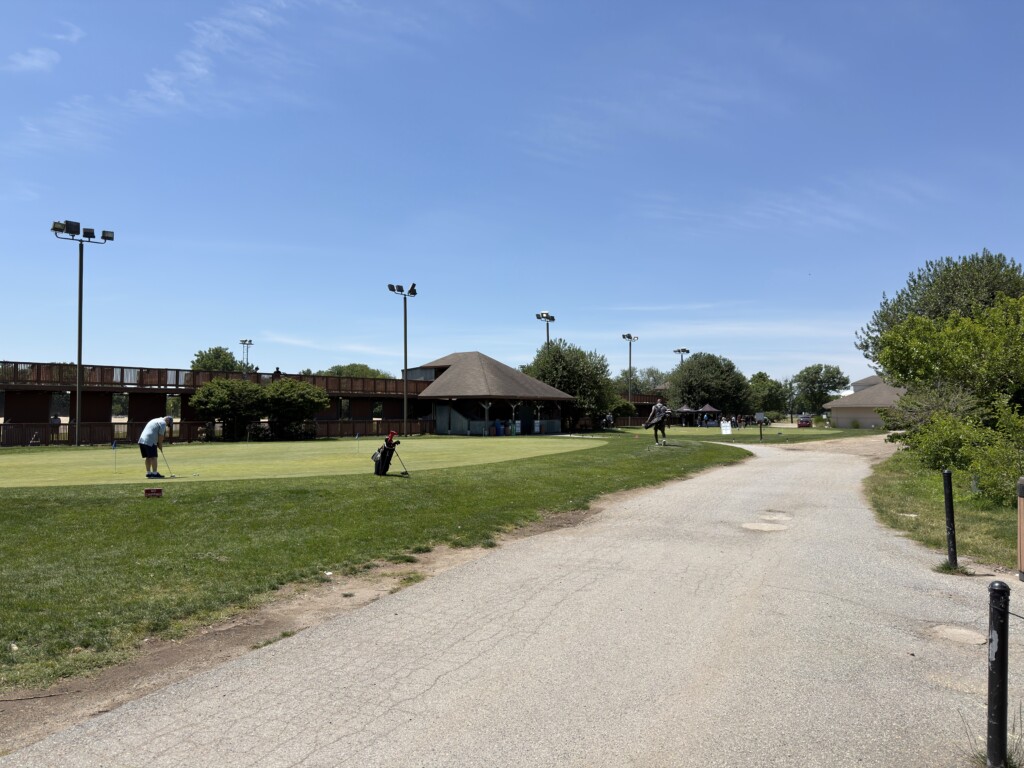
For those coming to practice, the 100-stall double-decker range with lights is the default stop. It’s outfitted with Toptracer units, but the calibration seems off as distance and speed are usually overstated. Perhaps that has something to do with the balls, whose dimples have seen better days. There are putting greens, but they are decorated with no chipping signs. However, there are three short practice holes available to rent by the hour. They come with a shag bag of balls, and the best part is you can take those over to the range after.
The Potomac Grille serves one of the better cheeseburgers I’ve had in DC with a menu specializing in deep-fried, flat-top grill entrees. You’ll find more than golfers grabbing a bite there, with cyclists and tourists often among the patrons.
How a sandbar became the most-played golf in DC
The ground isn’t natural. By the mid-1800s the Potomac had silted up badly enough to choke shipping, and in 1882 Congress authorized dredging the flats and digging out the Tidal Basin. The officer who ran the reclamation is the point’s namesake, Major Peter Conover Hains. By 1911 the fill was finished, around 600 acres of new land sitting just above the tide, and the McMillan Plan had already earmarked it for recreation.
Golf arrived in 1917, when the park hired Walter Travis, a former national amateur champion, to lay out a course. Travis built a links-style 18 that could be played in either direction. The front nine opened in 1920 and the back nine by the summer of 1923, present-day Blue Course. It drew enough play that the concessionaire brought in William Flynn, whose third nine, today’s White Course, was built in 1924 and opened in 1925. A final nine, today’s Red Course, was in place by 1931.
From 1920, Black golfers could use the course only on restricted hours, Mondays after 4:30pm, then the next summer Tuesdays after 3:00pm. That held for two decades until the summer of 1941 when three members of African-American men’s Royal Golf Club challenged the status quo. Seeking better playing conditions than Langston golf course, they purchased a ticket on June 29 and were initially turned away. However, they came back and after park police ruled their tickets were valid, played all eighteen holes under a six-officer escort while a crowd heckled. The next day, Secretary of the Interior Harold Ickes ordered the course open to every player regardless of race, and extended it to the District’s other federal courses.
The decades after brought more transformation to East Potomac. In the spring of 1941 the Park Service pulled five holes off the then G course for ballfields displaced by the new Jefferson Memorial, and that December the Army set four anti-aircraft guns on the now White course, closing another nine and the driving range for the war. The Gordon firm redesigned the White Course in 1956, but by the early 1980s that nine was torn out entirely; after a golfers’ petition campaign, Congress put up $500,000 in August 1984, and it was rebuilt in 1984-85 to Gordon’s design. The operator that took over in 1983 spent the next two decades modernizing the Blue and Red and building the range you hit off today.
An uncertain future
The National Links Trust began a 50-year contract in 2020 to operate East Potomac (along with Langston Golf Course, and Rock Creek Park Golf). Renowned architect Tom Doak was set to renovate and restore the Blue Course with respect to its links heritage. However, after back and forth with the Trump Administration, that plan was scrapped.
As of June 2026: The courses are open and playing normally. Their future is unclear though. The proposal to rebuild the property as a single 18-hole course would, if it proceeds, end the 36-hole layout described above. However, nothing has been built and no official timeline has been announced.